
CHSP DEX Stage 3: The 15 New Mandatory Fields and What Providers Must Do Now
If your organisation delivers CHSP-funded services, you'll have noticed one of two things since August. Either your Data Exchange submissions started getting rejected, or your Funding Arrangement Manager (FAM) sent you a note about incomplete session records. Both trace back to the same change.
On 11 August 2026, the Department of Social Services turned on 15 new mandatory fields on CHSP session records in DEX. They collectively make up what the Department calls Stage 3 of the CHSP DEX implementation, and they cover things DEX never previously asked about — sub-contractor involvement, service location, overnight support, engagement time, transport details, and meal specifics.
There's no optional phase. There's no soft-launch. And the obligation is retrospective to 1 July 2026 — about six weeks before DEX started enforcing it.
Stage 3 has been enforced for six weeks now, and the retrospective gap has not closed itself. Here's what changed, what's required, and how to work through a July–August backlog that is already overdue.
Why Stage 3 exists
If you've been following our coverage of the July 2025 DEX changes, you'll know the Department has been progressively tightening what CHSP providers must report through DEX. Stage 3 is the next step.
The stated goal is to capture the hidden costs of CHSP service delivery — the things that don't show up in a simple hours-and-attendance record but that materially affect what it actually costs to deliver quality care. Was the session sub-contracted? Did a volunteer deliver it? Did it include overnight support? For meal delivery, how many mains vs. light meals were provided? For transport, how much of the time was the client actually in the vehicle?
Whether or not that data gives DSS a truer funding picture is a debate for another day. From a compliance perspective, the story is simpler: from 11 August 2026, sessions submitted without the required Stage 3 fields for their service type are rejected by DEX, full stop.
The 15 fields, at a glance
The Stage 3 field set breaks into four logical groups. You won't see all 15 on every Progress Note — DEX only asks for the fields that apply to the specific service type being reported.
Delivery arrangement (2 fields)
- Sub-contractor delivered — was the session delivered by someone who isn't an employee or volunteer of the funded organisation?
- Volunteer direct service — was the service delivered predominantly directly to the client by a volunteer?
Service context (2 fields)
- Service location setting — Home or Community.
- Overnight support included — did the session include overnight attendance at the client's home?
Engagement and travel (3 fields)
- Engagement time (minutes) — time spent with the client building connectedness and trust, over and above the service itself. Optional.
- Trip time (minutes) — travel time counted only while the client is in the vehicle. Optional.
- Trip distance (km) — pick-up to agreed destination. Optional.
Meals (8 fields)
- Meal provided — was a meal provided during the session?
- Meal cooked off-site — was the meal prepared somewhere other than the funded organisation's own location?
- Items texture-modified — was at least one meal in the session texture-modified?
- Main meals / Light meals / Desserts / Beverages / Snacks — counts, one per category.
For the full technical detail — DEX code names, data types, and the exact wording DEX uses to decide "mandatory" vs. "optional" — the definitive source is the CHSP Data Exchange Guide from 1 July 2026, published by the Department in July. Your FAM can supply it, or request it from the DSS Data Exchange helpdesk (details at the end of this article).
Which activities are affected
Seventeen CHSP program activities carry at least one Stage 3 requirement, across nineteen activity and service-type combinations — two activities, general respite and transport, split into two service types each with different requirements. Not every activity gets the same set, and that's the important part.
For example, Meal Delivery picks up the meal fields plus service location, engagement time, sub-contractor and volunteer questions. Domestic Assistance only picks up the sub-contractor and volunteer questions. Allied Health and Therapy Services picks up only the sub-contractor question.
The mapping between activities and fields is held by DEX itself — the Department returns the applicable field set for each (Program Activity, Service Type) combination through a DEX API call. So software vendors don't need to hardcode a table (and shouldn't — the Department has adjusted it before and will again).
Here is the full mapping, straight from the Department's Table 2:
| CHSP activity | Service type | Sub-con | Volunteer | Location | Overnight | Engage | Trip time | Trip km | Meal | Off-site | Texture | Counts |
|---|---|---|---|---|---|---|---|---|---|---|---|---|
| Allied health and therapy services | All | ✓ | ||||||||||
| Therapeutic services for independent living | All | ✓ | ||||||||||
| Community cottage respite | Cottage respite | ✓ | ✓ | ✓ | ✓ | ✓ | ||||||
| Home or community general respite | Community and centre-based respite | ✓ | ✓ | ✓ | ✓ | ✓ | ||||||
| Flexible respite | ✓ | ✓ | ✓ | ✓ | ✓ | ✓ | ✓ | |||||
| Domestic Assistance | All | ✓ | ✓ | |||||||||
| Group social support | All | ✓ | ✓ | |||||||||
| Hoarding and squalor assistance | Hoarding and squalor supports | ✓ | ✓ | |||||||||
| Home maintenance and repairs | All | ✓ | ✓ | |||||||||
| Individual social support | All | ✓ | ✓ | ✓ | ||||||||
| Meal delivery | Meal delivery | ✓ | ✓ | ✓ | ✓ | ✓ | ✓ | ✓ | ||||
| Meal preparation | Meal preparation | ✓ | ✓ | |||||||||
| Nursing care | All | ✓ | ||||||||||
| Personal care | All | ✓ | ||||||||||
| Transport | Direct transport | ✓ | ✓ | ✓ | ✓ | ✓ | ||||||
| Indirect transport | ✓ | ✓ | ✓ | ✓ | ||||||||
| Home adjustments | Home modifications | ✓ | ✓ | |||||||||
| Equipment and products | All | ✓ | ||||||||||
| Specialised Support Services | Vision advisory services | ✓ | ✓ |
Reading the columns: Sub-con = sub-contractor delivered · Volunteer = volunteer direct service · Location = service location setting · Overnight = overnight support included · Engage = engagement time · Trip time / Trip km = travel counted while the client is in the vehicle · Meal = meal provided · Off-site = meal cooked off-site · Texture = items texture-modified · Counts = the five meal-count fields (mains, light meals, desserts, beverages, snacks).
Source: Table 2, CHSP Data Exchange Guide from 1 July 2026.
The 1 July retrospective obligation
Here's the part that has caught most providers off guard.
DEX went live with Stage 3 on 11 August. But the Department's position — set out in the February 2026 CHSP DEX Implementation Update — is that providers should have been capturing the underlying information from 1 July 2026 in their own systems, ready to enter into DEX once the fields went live.
That creates roughly a six-week backfill window. Any CHSP session delivered on an affected activity between 1 July and 10 August 2026 has a Stage 3 data gap that DSS expects to see closed. The window itself shut on 10 August; the obligation to fill it did not, and every week that passes makes the detail harder to reconstruct from memory.
Practically, that means:
- For sessions delivered after 11 August, capture the Stage 3 data at the time of the session — same as any other Progress Note field.
- For sessions delivered between 1 July and 10 August, revisit the record. If your team logged the details in a separate notebook, a roster app, or a spreadsheet, transcribe them into the session record now.
If you have no record at all of engagement time, meal counts or sub-contractor status for a given July session, the honest answer is to enter the best estimate you can substantiate and flag it in your internal notes. DSS's expectation is that the record is eventually complete and accurate — not that impossible detail is fabricated to close a gap.
What providers need to do now
1. Confirm which of your services are affected
If you deliver any of the affected activities above, at least some of your sessions are in scope. If none of your activities appear, Stage 3 may not affect your submissions — but confirm with your FAM before assuming.
2. Set up data capture at the point of service delivery
Whatever system your team uses to record sessions — paper notes, a rostering tool, a case management system — the Stage 3 fields need to become part of the workflow. Waiting until end-of-month reconciliation is a recipe for guessing.
3. Close the 1 July → 10 August backlog — this is the overdue one
Filter your session records for that six-week window on your affected services and work through them one by one. Those notes were created before the fields existed in DEX, so the Stage 3 entries will simply be blank — you're not hunting for errors, you're filling in gaps. If you haven't started, do this before anything else on the list.
4. Monitor your DEX submission status
Sessions that don't pass DEX's server-side validation come back with a rejection message. Read the message — it usually names the field DEX is unhappy about. Don't ignore rejections thinking they'll clear on retry; they won't.
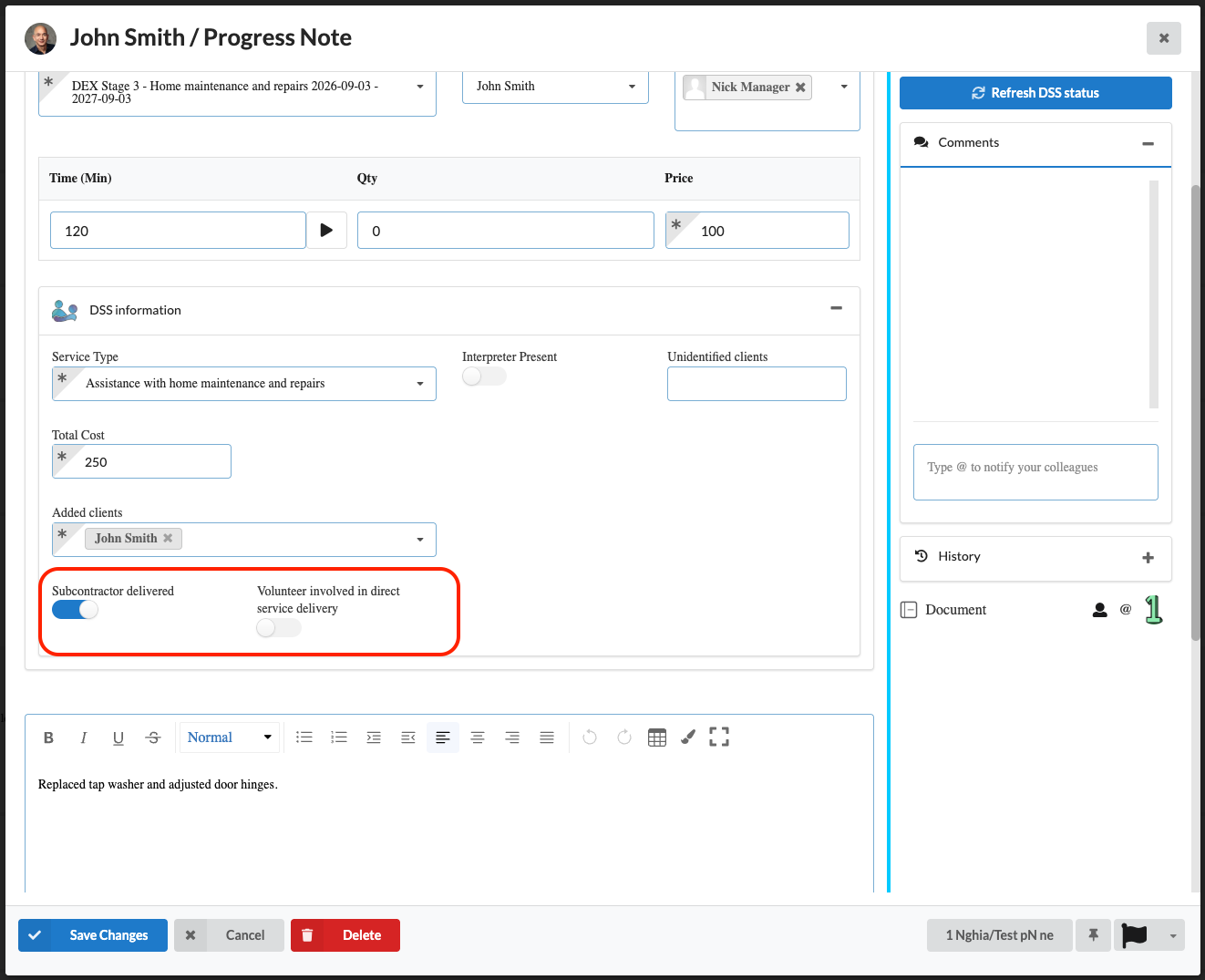 A Home Maintenance and Repairs session in Comm.care, with the Stage 3 fields — Subcontractor delivered and Volunteer involved in direct service delivery — rendering directly on the Progress Note.
How Comm.care handles Stage 3
If your organisation uses Comm.care, the Stage 3 fields appear directly on the Progress Note. There's nothing new to configure — the moment your organisation's DSS reference data is synchronised, the correct fields render for each service type.
The design decisions worth calling out, if you're comparing software:
- Fields are gated per service type, sourced from DEX rather than a hardcoded rules table. When DSS adjusts what's required, Comm.care follows without waiting on a software release from us.
- Reopening an older Progress Note now shows the Stage 3 fields, even if the note was created before 11 August. No delete-and-recreate, no support ticket, no locked records — just open, fill in, save, and Comm.care re-submits.
- Optional fields stay optional. DEX marks engagement time, trip time and trip distance as optional; Comm.care doesn't force you to invent numbers to save a note.
- DEX rejection messages are shown verbatim on the Progress Note, without re-wording or filtering. When something goes wrong, you see what DEX actually said.
One thing worth knowing: in several places, the fields DEX actually enforces at runtime don't match Table 2 of the CHSP Data Exchange Guide. We documented every discrepancy we found while building Stage 3 into Comm.care — if your sessions are still being rejected after you've filled in what the guide says is required, that's likely why. See Why the Stage 3 DEX fields you see may differ from the CHSP guide.
For the full walk-through, see our help articles:
- CHSP Stage 3 — What Changed on 11 August 2026 — the full context, the 19 affected activities, and the retrospective obligation.
- Recording Stage 3 Fields on a Progress Note — the field-by-field tutorial.

We'll show you how Comm.care surfaces only the Stage 3 fields DEX asks for — and reopens older notes with the fields ready for backfill.
FAQ
Do I need to resubmit sessions that were already accepted by DEX before 11 August?
No. Sessions accepted by DEX before Stage 3 went live remain accepted. The Department has not indicated it will retrospectively reject historic sessions. The 1 July retrospective obligation is about what you record from that date forward, not about invalidating what's already on file.
What if I don't have the Stage 3 details for a July session?
Record the best information you can substantiate — from your own notes, from your worker's memory, from the client if appropriate — and note the gap in your internal records. Do not fabricate numbers to close a form. If your FAM raises the gap, an honest account of a partial record is a better position than a suspiciously clean one.
Will DEX ever change the mandatory/optional split?
Yes — the Department has adjusted DEX requirements at every stage so far, and there's no reason to assume Stage 3 will be different. This is why the software you use should read the requirement set directly from DEX rather than shipping a hardcoded table. If your vendor tells you a Stage 3 field is fixed as mandatory in their code, ask them what happens if DSS changes it.
My software isn't ready for Stage 3 — what do I do?
Contact your vendor first and ask for a firm delivery date. If they can't give you one, or the date pushes past what your FAM can wait for, keep detailed notes of the Stage 3 data outside the system and be prepared to enter it once support lands. Reply to this article and we can walk through Comm.care as an option — we ship the Stage 3 fields today and can talk about a migration path if it's the right fit.
Where can I read the DSS source documents?
The primary references are the February 2026 DEX Implementation Update and the CHSP Data Exchange Guide from 1 July 2026. Your FAM can supply the latter, or you can request it via the DSS Data Exchange helpdesk on 1800 020 283.
Sources: Department of Health and Aged Care — CHSP DEX Implementation Update February 2026, CHSP Data Exchange Guide from 1 July 2026, DEX Training Resources.