
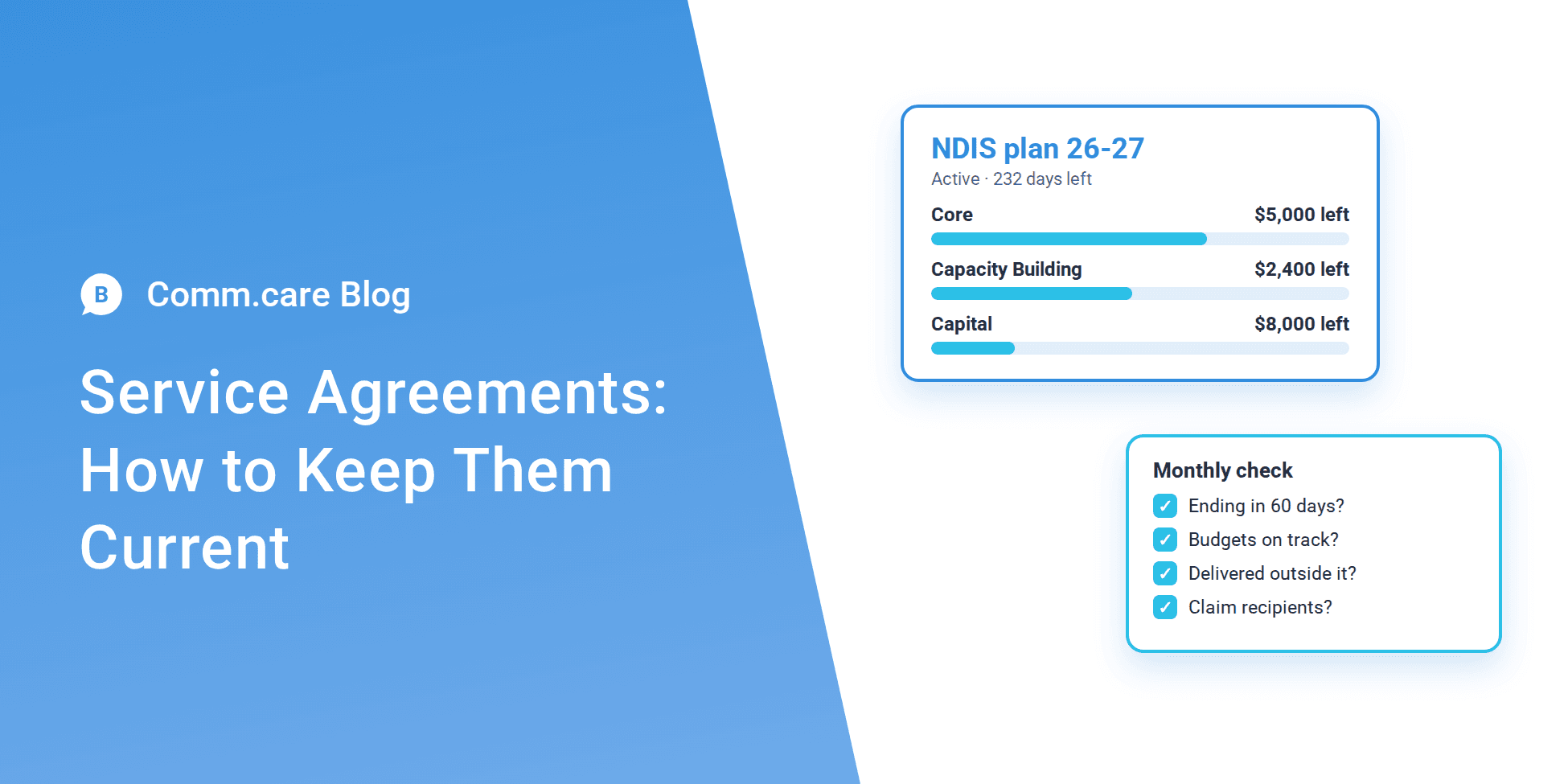
Most service agreements are signed at intake, filed, and not opened again until something goes wrong. By then the services have changed, the plan has been reviewed, and the agreement describes a client you supported a year ago.
A service agreement is only useful if it's current. This post covers what a good one holds, whatever the funding source, and a simple routine that keeps it up to date.
What a service agreement is for
A service agreement is the written record of what you and your client agreed: which supports, for how long, who pays and with what budget.
That's true for every funding source. An NDIS participant, an older person on Support at Home or CHSP, and a client paying privately all need the same clarity. The rules differ. The purpose doesn't.
For NDIS and Support at Home providers the detail matters a lot, including what to put in and when it must be signed. We cover that in NDIS service agreement: what to include.
What a good service agreement holds
Whatever the funding source, a good agreement answers six questions.
- What supports will you deliver? In plain words the client understands, with how often and where.
- For how long? A start date, an end date and when you'll review it.
- Who pays, and how? The funding source, and for NDIS how the plan is managed: NDIA managed, plan managed or self managed.
- What's the budget? Broken down the way the funding is. An NDIS plan has three budgets: Core, Capacity Building and Capital. A CHSP service may sit under a specific Outlet Activity.
- Who gets the invoices or claims? The client, a carer or a plan manager.
- What happens when things change? Cancellations, changes to services, complaints and how to end the agreement.
If any of these lives only in someone's head, the agreement isn't finished.
Why agreements go stale
Agreements rarely go stale in one go. They drift.
- A service is added after a phone call, and the agreement isn't updated.
- A plan review moves money between budgets.
- A plan manager changes, and invoices go to the old one.
- The person who wrote the agreement leaves.
The bigger reason is structural. The agreement sits in a folder. Delivery sits in the roster and the progress notes. Claims sit somewhere else again. Nothing connects them, so nothing tells you when they stop matching.
How to keep it current
You don't need a big process. You need the agreement to be part of everyday work.
1. Link delivery back to the agreement
Every appointment and progress note should point at a service in a current agreement. If a worker delivers something that isn't in any agreement, you want to know that day, not at the audit.
2. Watch the budget against time
Spending 50% of a budget by the halfway point of the plan is on track. Spending 80% is a conversation to have now, while there's still time to adjust supports. Check this monthly for each budget, not just the total.
3. Set a reminder before the end date
Put a review reminder four to six weeks before the agreement ends. That leaves time to talk with the client, and their plan manager or coordinator, before anything lapses.
4. Renew from the last agreement
When a plan ends, most of the agreement carries on: the same services, the same claim settings, often the same people. Start the new agreement from the old one and change only what's new. We'll cover this in more detail next week.
5. Do a short monthly check
Once a month, for each coordinator's clients:
- Agreements ending in the next 60 days
- Budgets running fast or slow against time
- Services delivered that aren't in an agreement
- Claim recipients that have changed
If it takes minutes, you're in good shape. If it takes an afternoon, the agreement and the delivery live too far apart.
How Comm.care keeps agreements current
We rebuilt how Comm.care handles this in November 2026. Every client now has Service Agreements on their Circle of Care, and they work the same way for every funding source.
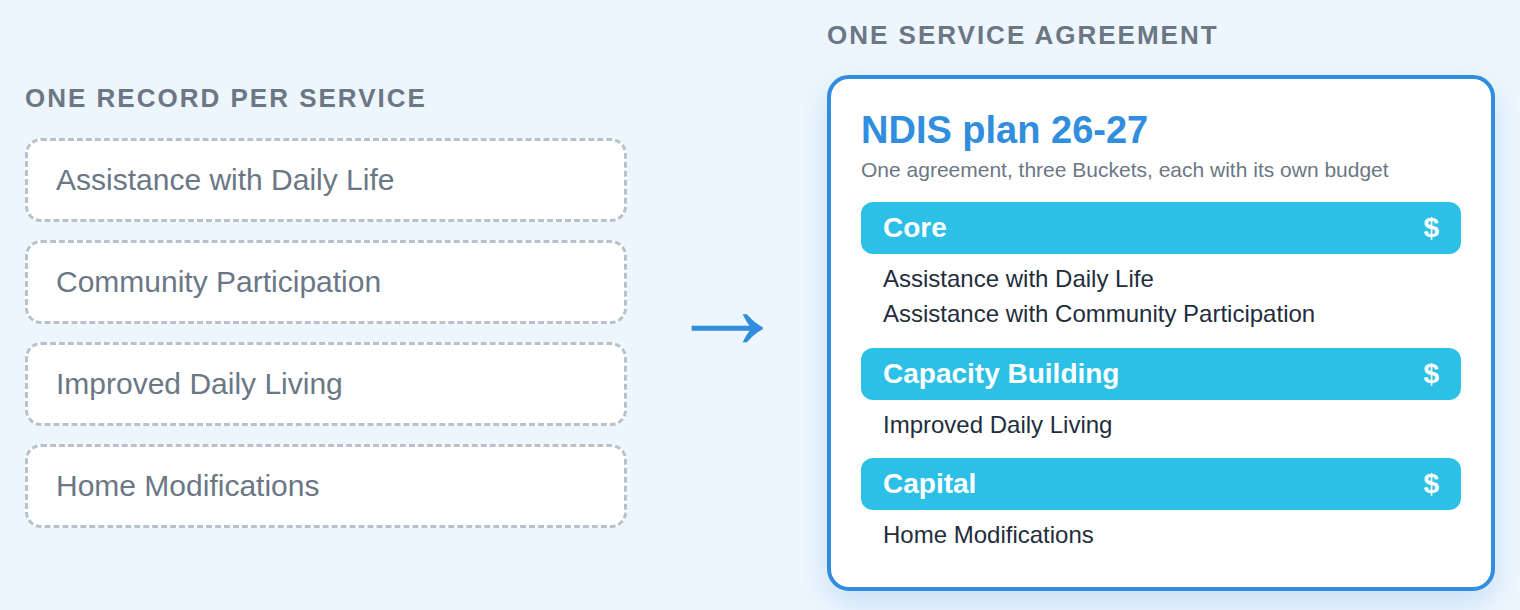
- One agreement, every budget. An NDIS agreement holds Core, Capacity Building and Capital together, each with its own budget and funding periods.
- Delivery is connected. Each progress note and appointment points at a service in an active agreement. Spend is worked out every night.
- At a glance: what's spent, what's left and how many days remain, for each agreement and each budget.
- Reminders and renewals. A renewal reminder before the end date, and one click to start the next agreement from the current one.

See how it works in our help guide: About Service Agreements.
Frequently asked questions
Does every client need a written service agreement?
It depends on the funding source and how you're registered. For NDIS, see NDIS service agreement: what to include. Even where it isn't required, a written agreement protects both you and the client.
How often should I review a service agreement?
At least at every plan review, and whenever the supports change. A monthly check of budgets and end dates catches most problems early.
Can a client have more than one agreement?
Yes. A client may have one for NDIS supports and another for private services, or two in a row while a new plan starts. Keep each one clear on its dates, funding and budget.